
What is Cup lock Scaffolding: Parts, Uses & How to assemble?
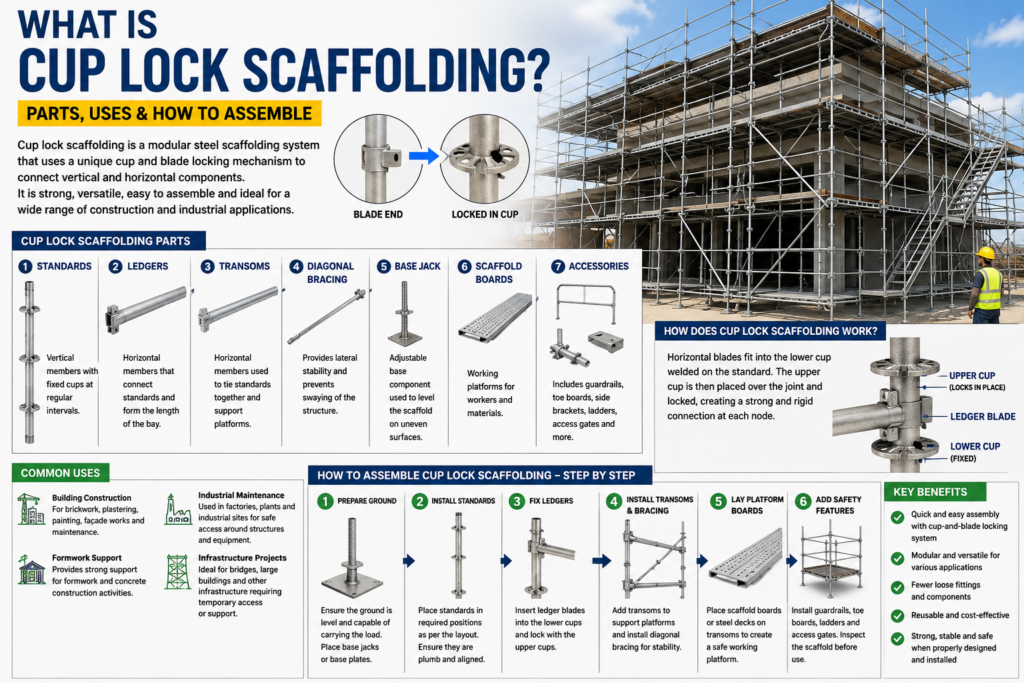
Scaffolding is an important part of modern construction. It provides safe access and temporary support for workers and materials and equipment at various heights. One of the modern scaffolding systems that has become popular because of its modular design, quick assembly, strength and versatility is cup-lock scaffolding.
Unlike the conventional tube and coupler scaffolding, the cuplock system has a unique cup and blade connection. That makes it easier to join vertical and horizontal elements efficiently with fewer loose fittings. The system is suitable for construction, industrial maintenance, infrastructure works, façade works, access platforms and formwork support.
In this guide we will look at what cuplock scaffolding is, its main components, common uses, benefits and the basic assembly process.
What is a cuplock scaffold?
Cup lock scaffolding is a modular steel scaffolding system used to create stable temporary structures for access and support. The most characteristic feature of it is the coupling of cup and lock on the vertical standards.
The standards have fixed lower cups at regular intervals. Movable upper cups are used for securing the blade ends of horizontal components. Multiple components can be connected at a single node, and depending on the system design this results in a structured and rigid framework.
That means cup-lock scaffolding can be erected and dismantled relatively quickly compared with systems that depend heavily on separate bolts, clamps and couplers.
Cup lock Scaffolding Parts
A cup-lock scaffold is composed of a series of standardised components. Each part contributes to making sure the structure is safe and stable.
1. Norms
Standards are the vertical parts of the scaffolding system. They are the primary structural framework and transmit loads to the supporting surface.
Cup lock standards have welded cup connections at regular intervals, allowing ledgers, transoms and other components to be attached at consistent levels.
2. Accounts
Ledgers are horizontal members that join the vertical standards. They determine the length and width of the individual scaffold bays and contribute to the overall stability of the structure.
Ledger ends have blades which fit into the cup connections on the standards.
3. Transoms
Transoms are horizontal members used to tie standards together across the width of the scaffold and to support working platforms.
They can assist in the distribution of loads of scaffold boards or planks and are particularly important when forming properly supported working platforms.
4. Diagonal Bracing
Diagonal braces provide extra lateral stability. They help in controlling the movement and prevent the scaffold structure from becoming unstable due to lateral forces.
The arrangement of bracing should be determined according to the design, configuration, height, loads, site conditions, and applicable safety requirements for the scaffold.
5. J-Bases
The standards are supplied at the bottom with base jacks or adjustable base components. They help to level the scaffold when the base surface is not perfectly level.
Having proper base support is important because uneven or unstable foundations can affect the alignment and stability of the whole scaffold.
6. Scaffolding boards
Planks or steel platforms are used to create the working surface for personnel and materials. They should be adequately supported, anchored and selected for the loading requirements.
7. Mounts and Accessories
Other components such as side brackets, guardrails, toe boards, ladders, access gates and other accessories may be required depending on the project.
The exact components depend on whether the cup lock system is used for access scaffolding, formwork support, industrial maintenance or other applications.
How Does Cup lock Scaffolding Functions?
Cup lock scaffolding is based on the main principle of its cup-and-blade locking mechanism.
The horizontal part, for example, a ledger, has a blade or end fitting that fits into the lower cup attached to the standard. The connection is then covered with the upper cup, which is sometimes hammered into place, locking the joint.
This leads to a compact connection between the vertical and horizontal components. The system can be designed to allow for more than one component to be assembled at one connection point. This can help to create a strong and organised modular system.
The system is convenient for repetitive construction and dismantling operations, as many connections can be made without separate loose couplers.
General Cup lock Scaffold Erection Steps
Cup lock scaffolding shall be erected, modified and dismantled by trained and competent personnel in accordance with the manufacturer’s instructions, the project design and applicable regulations.
The typical process involves the following steps:
Step 1: Clean the Ground
Inspect and prepare the support surface before assembly. It must be able to carry the loads of the planned scaffold.
Base plates or adjustable jacks are positioned to form a stable foundation.
Step 2: Apply the Standards
Place the vertical standards in the required positions as per the scaffold layout.
Standards should be correctly aligned and spaced as per approved design.
Step 3: Mount the Ledgers
The cup and blade mechanism connects between the horizontal ledgers and the standards.
The connections should be locked properly before going to higher levels.
Step 4: Install Transoms and Bracing
Fit transoms to support platforms and provide diagonal bracing as necessary.
Support is especially critical to resist lateral movement and to keep you stable.
Step 5: Build Working Platforms
Fit proper scaffold planks or platforms on the supporting members. The arrangement of the platform shall meet the applicable design and safety requirements.
Step 6: Add Guardrails and Access
Install required guardrails, toe boards, ladders, gates and other safety features.
Before releasing the scaffold for use, it should be checked.
Basic Cup Lock Scaffolding Assembly procedure
Cup Lock Scaffolding Common Uses
The cup lock scaffolding is applied in a wide range of construction and industrial applications.
Construction Building.
Temporary access for brickwork, plastering, painting, facade installation, repair and maintenance can be supplied.
Support for Formwork
With proper engineering design, the modular structure can also be configured as temporary support for formwork and concrete-related construction activities.
Industrial Maintenance
Factories, warehouses, power facilities and other industrial sites can use cup lock systems to construct temporary access platforms around equipment and structures.
Infrastructure Projects
Cup lock scaffolding is used in infrastructure projects such as bridges and large buildings, as well as other projects requiring temporary access or support systems.
Access Platforms and Towers
Its modular design means that it can be used by contractors to build access towers and working platforms for jobs where workers need to work at different heights.
According to the company, Epee’s cup lock scaffolding system is suitable for access scaffolding, support frameworks, load bearing platforms and other construction needs.
Benefits of cup lock Scaffolding
There are several practical advantages to cup lock scaffolding:
Quick assembly: The cup-and-blade mechanism is conducive to repetitive connections.
Modular design: Components can be configured to different project requirements.
Decreased loose fittings: The connection system reduces the reliance on a large number of separate couplers.
Multi-purpose: Suitable for access, support, platforms and industrial applications.
Reusable components: Components that are in good condition can be used in many projects.
Easy dismantling: The same modular connection principle can make removal simple.
Good structural stability: If properly designed, erected, braced and supported the system can provide a stable temporary structure.
cup lock Scaffolding and Traditional Scaffolding
Standard tube and coupler scaffolding usually uses separate couplers or clamps to connect tubes. Conversely, the vertical standards of cup lock scaffolding have standard connection points built into them.
This can make cup lock particularly attractive for projects with repetitive scaffold configurations and relatively quick installation.
But the choice of the best scaffolding system depends on the project requirements, the site conditions, the design, the loads, the available components, and the safety standards that apply.
Safety issues
Safety on scaffolding should always be a priority. The fact that cup lock scaffolding has a quick or easy to assemble connection system does not mean it should be considered safe.
Where necessary the scaffold should be properly designed and erected by competent persons, properly supported and braced and inspected before use and after relevant changes or events.
Check components for excessive corrosion, deformation, cracks, damaged cups, damaged blades or other defects. No broken parts are to be used.
Discussion
cup lock scaffolding is a modular scaffolding system that uses standardized steel components and a practical cup and blade locking system. It has the ability to effectively connect vertical standards, ledgers, transoms and braces and is suited to many construction and industrial applications.
Whether building facades, maintenance platforms, formwork support or infrastructure projects, with the right design and installation, cup lock can provide a flexible solution.
For contractors and construction companies, the choice of quality components and the application of appropriate assembly and safety procedures are key to achieving the desired performance of the system.
Visit Epee to learn more about cup lock scaffolding products and solutions.
Frequently Asked Questions
What is cup lock scaffolding?
Cup-lock scaffolding is a modular steel scaffolding system where vertical standards connect to horizontal components (ledgers and transoms) using cup-and-blade connections.
What are the major components of cup lock scaffolding?
Key components include standards, ledgers, transoms, diagonal braces, base jacks or base plates, scaffold planks, guardrails, brackets and a range of access and safety accessories.
What is the function of cup lock scaffolding?
Cup lock scaffolding is used for building construction, façade works, industrial maintenance, access towers, working platforms, infrastructure projects and temporary formwork support.
Is cup lock scaffolding easy to installation?
It has a standard cup and blade connection system for fast assembly and disassembly. However, scaffolding should always be erected and modified by trained competent persons in accordance with the approved design and the manufacturer’s instructions.
What are the benefits of cup lock scaffolding?
Key benefits include modular construction, efficient assembly, versatility, reduced reliance on loose fittings, reusability, and the ability to create different access and support configurations when properly designed and installed.