
U-Head Jack vs Base Jack Differences, Uses and Applications
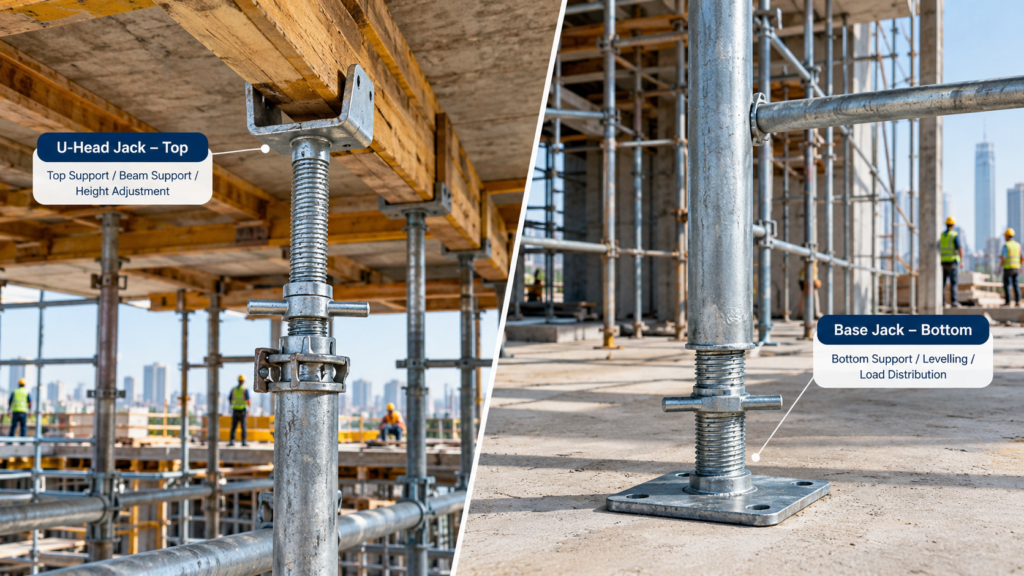
In today’s construction, scaffolding systems must be stable, flexible and allow for precise height adjustment. The U-Head Jack and the Base Jack are two important components which are widely used in scaffolding and temporary support systems. Both are scaffolding fittings which are adjustable, but they serve different purposes and are fitted at different points in a scaffolding structure.
Knowing the difference between a U-head jack and a base jack can help contractors, engineers and construction professionals select the right component for their projects. Good choices enhance the scaffold’s stability, level, load distribution and overall performance.
If you are looking for reliable scaffolding components, manufacturers such as Expee will have solutions designed for construction and industrial applications.
What Is a U-Head Jack?
U-Head Jack is a type of adjustable scaffolding element with a U-shaped head that is used to support beams, timber sections, steel channels and other structural elements. It is usually fitted on the top of scaffolding systems like Cuplock, Ringlock and other modular scaffolding systems.
The head is U-shaped, so the beams can rest in it and be helped to stay in place. The threaded adjustment mechanism allows workers to increase or decrease the height of the support as required by the project.
U-Head Jack The U-Head Jack has an adjustable design and is especially useful for projects that require precise elevation adjustments in slab construction, formwork, shoring and structural support.
What is a Base Jack
A Base Jack, also known as an adjustable base jack or scaffolding base jack, is fitted at the bottom of a scaffolding structure. Its main purpose is to provide a stable base and allow workers to vary the height of individual scaffolding standards.
Construction surfaces are not always perfectly flat. A Base Jack compensates for uneven ground to ensure the scaffolding system is properly levelled before work begins.
Unlike a U-head component, Base Jack works at the bottom of a support structure and not at the top. It transfers loads toward the supporting surface.
U-Head Jack and Base Jack: The Main Differences
Both components use threaded adjustment mechanisms, but they are used for different purposes and in different applications.
Feature | U-Head Jack | Base Jack |
Position | Top of scaffolding/support system | Bottom of scaffolding system |
Main purpose | Supports beams and structural members | Levels and supports scaffolding |
Head design | U-shaped head | Base plate |
Common application | Formwork, slab support, shoring | Scaffolding foundation and levelling |
Adjustment | Provides vertical height adjustment | Provides vertical levelling adjustment |
Primary function | Beam/support positioning | Stability and load transfer |
The easiest way to remember the difference is that a U-Head Jack is generally used to support and adjust the height of members at the top, while a Base Jack provides adjustment and stability at the bottom.
U-Head Jack Main Applications
U-Head Jack has a variety of applications in construction because it can provide controlled vertical adjustment.
1. Slab Formwork
One of the most common applications is slab formwork. When producing concrete slabs, beams and formwork components have to be placed at the right height.
The head is U-shaped so the beams can sit securely. A threaded mechanism allows you to adjust the height exactly.
2. Support systems
U-head components are very useful in temporary shoring where structural members need to be supported with adjustment. Contractors can set the height to fit the site conditions and structural needs.
3. Support of the beam
The U-Head Jack can be used to support timber beams, steel beams, channels, and other compatible structural members. The top is U-shaped to assist in keeping the member in place.
4. Formwork for construction
You need to set the formwork in place correctly before you pour concrete. Adjustable jacks can assist workers to achieve desired elevation and maintaining the desired formwork arrangement.
5. Temporary Strong Supports
U-head components can be used in temporary support structures where vertical adjustment is needed depending on the design, dimensions, material, and load rating.
Base Jack Uses
In the systems of scaffolding, Base Jacks have a different but equally important role to play.
1. Scaffolding Levelling
A Base Jack is used to level out uneven ground for workers. The threaded stem allows for the height adjustment of individual standards.
2. Ground support services
The base plate spreads the load over a wider area than just the end of a standard. This helps to create a more stable base for the scaffolding system.
3. Height Adjustment
The Base Jacks allow for vertical adjustment at the bottom of scaffolding structures. This makes them useful where the supporting surface varies in elevation.
4. Scaffolding systems in modular form
These are commonly used in modular scaffolding systems, especially those where the vertical standards have to be individually levelled.
Why Is a U-Head Jack Needed in Formwork?
The control of height is very important in concrete formwork. Relatively small changes in elevation can alter the positioning of beams and formwork components.
A U-Head Jack enables an adjustable connection between the vertical support and the beam or structural member. The workers can adjust the mechanism to the required height and then lock the arrangement.
The U-shaped head also offers a convenient place to sit on compatible beams, which helps to keep them in place during construction.
However, the right component must always be selected according to the structural requirements of the project, the manufacturer specifications, and the safety procedures in place.
What Is a Base Jack in Scaffolding, and What Does It Do?
Scaffolding is often set up on surfaces that may be slopes, or a slight change in elevation. If the standards are not levelled properly, the whole structure can become unstable.
An adjustable base jack makes it easier for the scaffolding team to set a more uniform working level. This is especially important when building multi-level scaffolding systems.
A properly fitted Base Jack also assists with spreading the load over the supporting surface. Ground conditions, load requirements, sole boards and other site-specific factors should be evaluated by competent professionals.
U-Head Jack and Base Jack: What’s the Connection?
Sure. Complete adjustable support systems for many scaffolding and temporary support arrangements may be provided by using a U-Head component and a Base Jack.
The base jack can provide adjustment and support at the bottom,, and the U-head jack can provide adjustable support at the top.
This combination can be especially useful for applications where fine adjustment is needed at both ends of a vertical support. The actual configuration is determined by the scaffolding system, design requirements, loading conditions, and the manufacturer’s specifications.
Choosing the Right U-Head Jack
Contractors must look beyond the price when selecting a U-Head Jack. The component should be compatible with the overall scaffolding or formwork system.
Key elements are:
Material Quality:
Look for components made from appropriate grades of steel and designed for construction applications. The quality of materials can affect the durability, strength and service life.
Maximum Load
According to the engineering design, the required load capacity should be established. Don’t assume that all adjustable jacks have the same load-bearing capability.
Thread quality:
The threaded stem shall provide a smooth, controlled adjustment. Reliable height adjustment relies on proper threading.
U-Head Size
The size of the U-shaped head should be compatible with the beams or structural members it supports.
Production Standards
Select components manufactured to consistent size and quality control procedures. Also, product specifications and technical information can be obtained from reliable manufacturers.
Finish of Surface
A good surface treatment can help to improve corrosion resistance, particularly where components are exposed to challenging site conditions.
Choosing the right base jack
For a Base Jack consider the required range of adjustment, the size of the base plate, the quality of the material, the load requirements, the quality of the thread and the compatibility with the scaffolding system.
The base plate should bear solidly on the supporting surface, and the threaded stem should afford sufficient adjustment for levelling.
Another thing to consider is purchasing scaffolding accessories from an experienced manufacturer or supplier who can guarantee consistent product quality.
U-Head Jack Uses in Construction Projects
The U-Head Jack is versatile and can be used for residential, commercial, industrial and infrastructure projects. It can be used for formwork, shoring, support of slabs, support of beams and temporary structural support arrangements.
Consistency is very important for big construction projects. Standardised component dimensions can facilitate installation , adjustment , inspection and replacement .
Contractors should always refer to the engineering design and manufacturer instructions and not solely rely on the general product descriptions.
Why Should You Buy Scaffolding Components From a Reputable Manufacturer?
The components of scaffolding directly influence the performance of temporary structures. Using components of poor quality or specifying them incorrectly can create unnecessary risks and operational problems.
A reputable manufacturer can provide:
- Consistent product sizes
- Appropriate material quality
- Product Data, Technical
- Quality control during production
- Various sizes and configurations
- Bulk Supply Capability
- Technical assistance
- Proper surface finishes
Companies in India looking for scaffolding products can choose to deal with an experienced manufacturer. This can ease the procurement process and help maintain consistency in large projects.
Concluding Words
The U-Head Jack and the Base Jack are both important adjustable parts , but they are used for different purposes . The U-head is mainly used for providing adjustable support to beams and structural members at the top of a scaffolding or formwork system. In contrast, the Base Jack provides bottom level support, levelling and load distribution.
The selection of the right U-Head Jack hinges upon material quality, load requirements, size, thread design, surface treatment, and overall system compatibility.
Select an experienced manufacturer like Expee that understands the demands of construction and industrial applications for dependable scaffolding and formwork solutions.
Frequently Asked Questions
1. What does a U-Head Jack do?
U-Head Jack is mainly used for the vertical adjustable support to beams, formwork and structural members. It has a U-shaped head for beams compatible seating and for height adjustment.
2. What is the difference between a U-Head Jack and a Base Jack?
A U-Head Jack is normally placed at the top of a vertical support to support beams or structural elements and a Base Jack is placed at the bottom to provide levelling, support and load distribution.
3. Can U-Head Jacks be used with slab forms?
Yes, U-heads are widely used in slab formwork and temporary support arrangements where controlled vertical adjustment of beams and formwork members is required.
4. Are U-Head Jacks variable?
Yes. In general a U-Head Jack will have a threaded adjustment mechanism that will enable the supported structure to be raised or lowered within the specified adjustment range.
5. How to select the right U-Head Jack?
Consider the load bearing capacity, dimensions, adjustment range, material, thread quality, U-head size, surface finish and compatibility with the scaffolding or formwork system. Follow the engineering requirements of the project at all times.
6. Where to Find the Best U-Head Jacks in India?
Reliable U-Head Jacks should be bought from reputable scaffolding manufacturers or suppliers who can provide product specifications, consistent manufacturing quality and appropriate construction grade components. One possibility is Expee for exploring scaffolding and associated construction solutions.